

Spring Waterfalls in Landscape Photography
Why Intention, Structure, and Restraint Matter

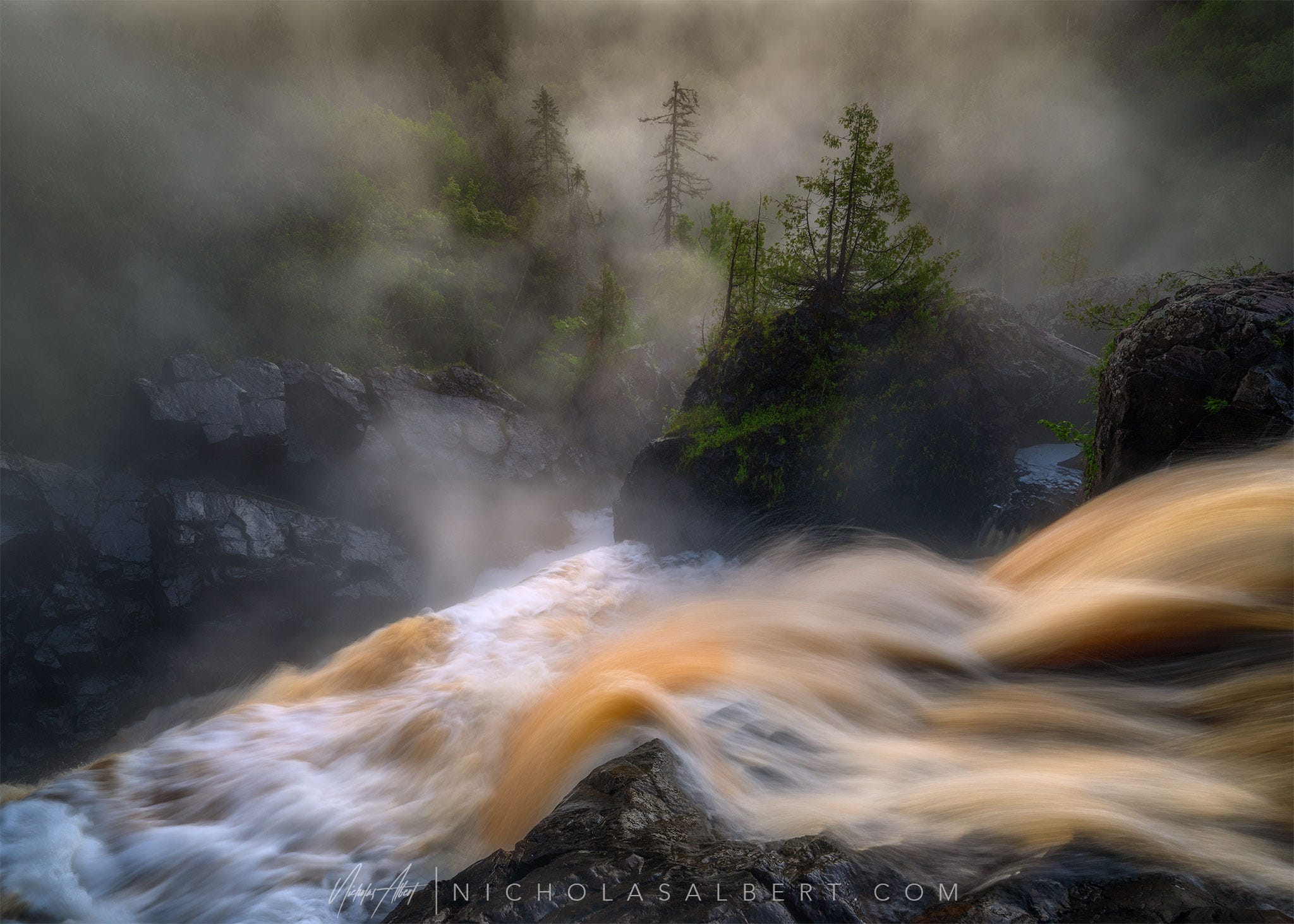
As landscape photographers, I think we naturally gravitate toward the changing of the seasons. For me, spring and autumn always come to mind first. These are the times of year when I feel most excited for what is ahead.
Spring is a beautiful season. Winter snowmelt, runoff, wet forests, thunderstorms, and moving water make the landscape feel alive again. Everything feels new. Everything feels alive. For years, I thought simply showing up with a neutral density filter and taking a long exposure meant I was creating strong photographs… I was wrong.
Here is the thing. The energy and movement of spring should absolutely be part of our photography, but they cannot be the only part. Over time, I have learned that spring photography depends far more on intention, structure, and restraint than raw intensity alone.
Spring waterfalls are exciting, but excitement by itself cannot carry a photograph.
BALANCE
As is the case with any photograph, everything depends on balance. In spring, I would argue that matters even more. Our first reaction is often to let the water become the entire photograph. I found myself making compositions that felt sloppy or poorly thought out, not because I was incapable, but because I was too focused on what the water was doing.
That is the trap. We see movement, energy, and emotion, and we stop asking whether the composition works. We start leaning on the drama of the water itself, hoping that will be enough. Sure, it is beautiful. But beauty alone still must be organized if it is going to carry meaning.
What we need to do as photographers is organize the chaos into a story. Moving water can dominate visual attention, and it can easily dominate our perception of a place while we are there. The secret to meaningful waterfall photography is not just energy. It is direction. The flow of the water, deadfall along the riverbank, the curve of the stream, or the line of a cascade can all help lead the eye through the photograph.
The question is not whether the water is dramatic. Of course it is. The question is whether we have organized it in a clean, coherent, visually pleasing way.
STRUCTURE
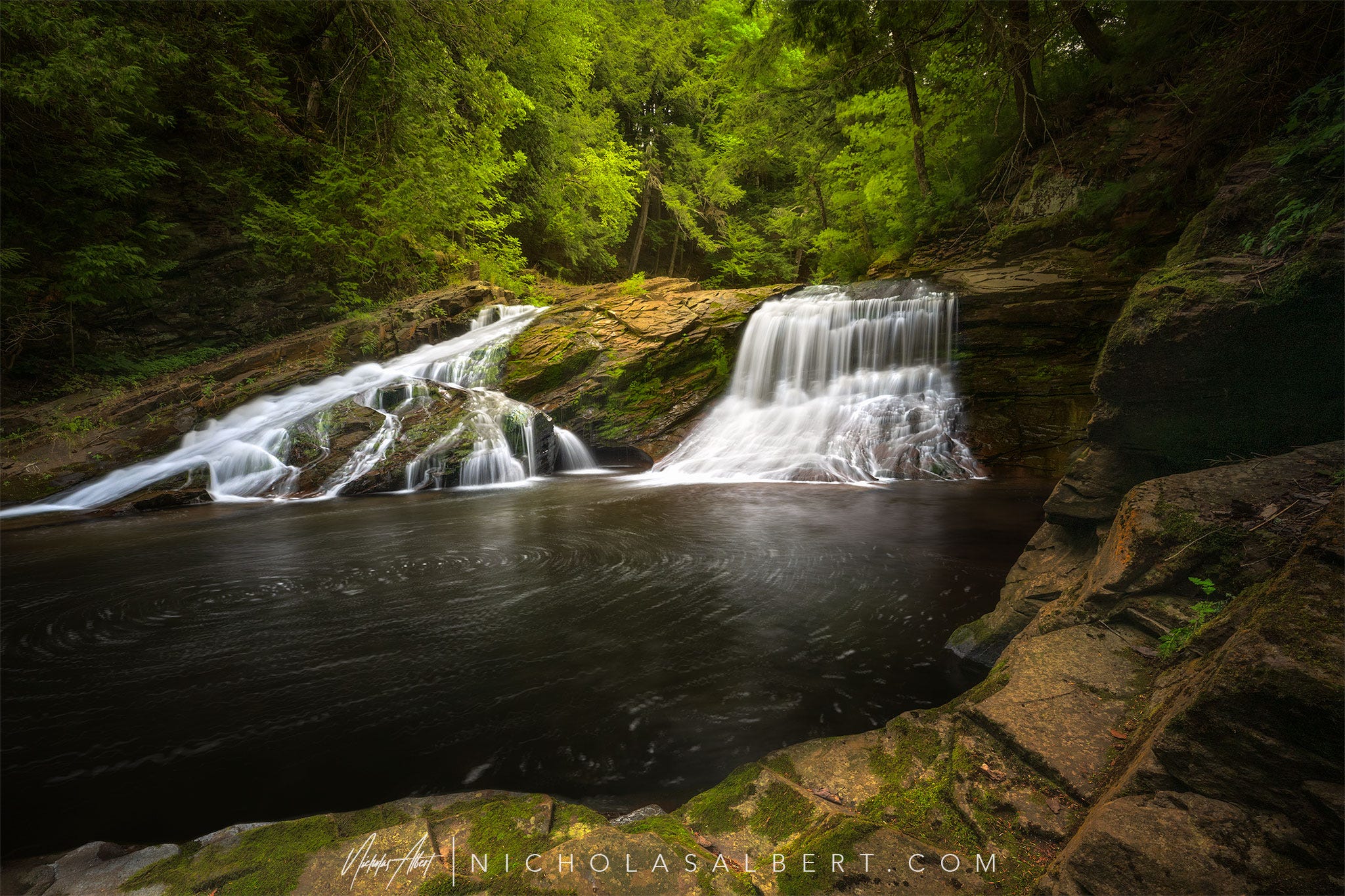
This is where we end up somewhere between conditions and composition. Conditions dictate the flow rate, the details, and the energy of the water. Composition decides the story. That is where our job begins. That is where visual design and decision making become the driving force behind the photograph.
What makes a waterfall photograph powerful is not the flow alone. It is the structure underneath it that decides what is important. A photograph of a beautiful, rushing waterfall still needs hierarchy, balance, and a clear relationship between the water and the surrounding landscape.
For me, this usually begins with simplification. At many waterfalls, I start with a telephoto lens and slowly add things back into the photograph as needed. That helps me establish the hierarchy of elements. In many cases, the subject sits in the midground, supporting elements help in the foreground, and the background provides context without becoming distracting. Of course, that changes from one photograph to the next, but the principle stays the same.
Everything needs room to breathe. The foreground cannot pull attention away from the subject, but the background cannot make up for a weak foreground either. The goal is to create visual flow and a clear relationship between all parts of the photograph.
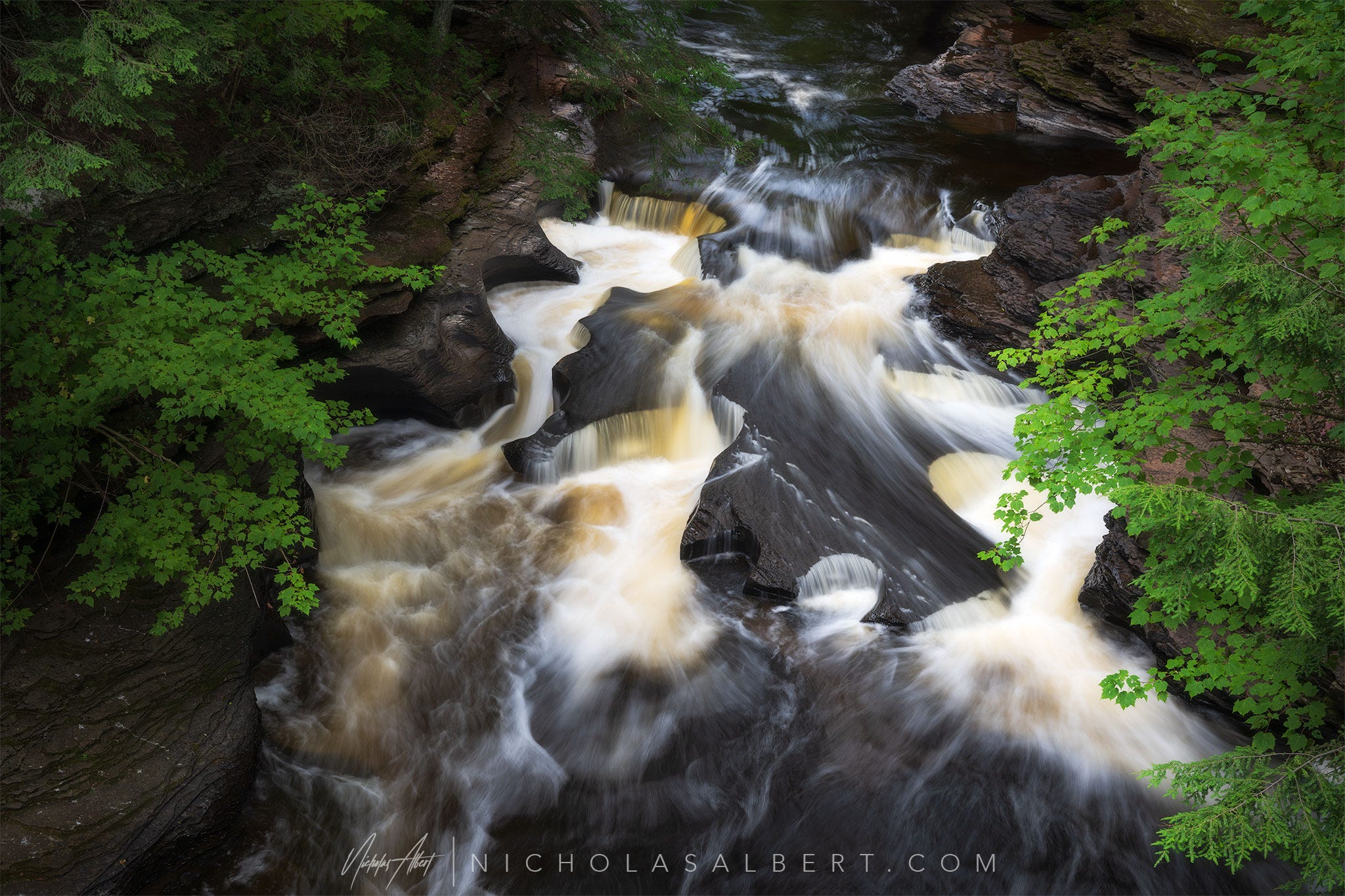
Once I have a foreground, subject, and background working together, I begin looking for what will hold those pieces together. Often, that glue is the water itself. I start paying attention to the lines in the water. Are there ribbons, bubbles, currents, or channels I can align with? Can I safely move to line those features up in a way that strengthens the composition?
Sometimes the answer is not in the water alone. It might be in a rock ledge, a bend in the riverbank, a piece of deadfall, or a ridge that helps build depth toward the subject while still supporting it. These features can simplify a foreground, provide natural framing, or help connect the layers of the photograph in a more intentional way.
When we think about structure, the goal should be depth first, then layering, then bringing those elements together through the water. Not building everything around the water just because it is the apparent part of the scene. Drama may draw us into the photograph at first, but structure is what gives it meaning beyond simple power.
RESTRAINT
What we need to do is work with restraint. It is essential to a clean, well thought out photograph. Restraint is what keeps the image from becoming overdone, and it keeps us from missing a better composition while standing in front of an exciting subject.
The water already carries visual energy. It usually does not need us to push it harder. It needs to be organized carefully and intentionally.
That means not always choosing the biggest or busiest section of the waterfall. It means simplifying instead of trying to include everything. It also means paying close attention to our technical and creative decisions.
Shutter speed becomes especially important here. Of course we want to show movement, but what kind of movement? Smooth ribbons? Rich texture and energy? A stronger sense of force? These choices matter just as much as hierarchy, balance, and visual flow.
We need to think of shutter speed as interpretation, not just what the meter says. Some waterfalls may call for a quarter second. Others may need several seconds. Others may feel better at a faster shutter speed altogether. We have to resist the urge to give every water photograph the same look.
Years ago, when I first started using ND filters, my first purchase was a 10-stop filter. I was thrilled that I could make 30-second exposures in broad daylight, but everything started to look the same. I leaned on post processing to try to bring detail back, which usually led to over-editing, heavy-handed contrast, and exaggerated color. Once I stopped approaching every location with the same idea, creativity started to open again.
The goal is not to make the water feel more dramatic than it was. The goal is to choose the interpretation that best supports the photograph.
CONTEXT
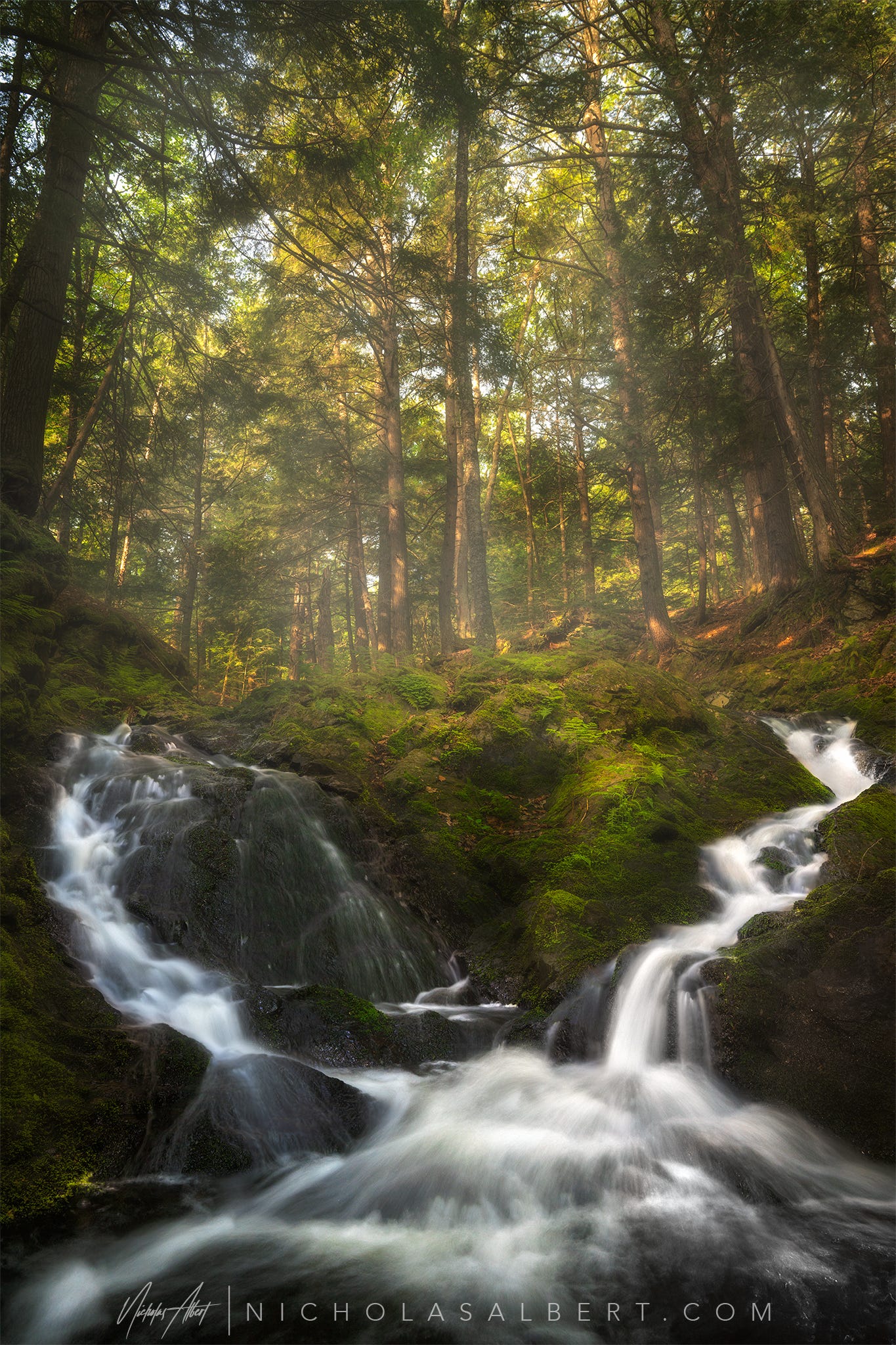
Water features become more meaningful when there is a clear relationship between them and their surroundings. The strongest photographs are rarely just about the water itself. They are about how the water interacts with shape, texture, color, and atmosphere in the landscape around it.
Think about wet rocks used as visual weight in the foreground. Moss or early spring greens used as supporting color. Branches, roots, stones, or smaller cascades used as rhythm from foreground to background, or even as natural framing. When we pay attention to these things, we can build the photograph around what is actually there instead of trying to force it later in post processing.
Even when the water is the subject, it still needs context. Yes, the water may be the main feature, but it becomes much stronger when the rest of the landscape helps carry the photograph too.
DISCIPLINE
I have learned a lot over more than two decades of photographing spring. One of the most important lessons has been learning not to confuse excitement with strength.
Spring is valuable to us as photographers because it teaches discipline. It asks us to slow down, pay attention to the movement of the water, organize that movement, and make intentional decisions based on structure rather than impulse. It teaches us the difference between loud and strong.
We need to ask better questions in the field. Where does the eye go first? Is the water guiding the composition, or overwhelming it? What surrounding elements help hold the photograph together? Are you choosing this composition because it feels powerful in the moment, or because it is actually well organized?
That is where growth happens. That is where we stop reacting to spectacle and start building photographs with patience, judgment, and control.
Control is more valuable than drama alone.
CONCLUSION
The best spring waterfall photographs are not always the loudest or most intense. More often, they are the ones with the clearest structure, the strongest relationships, and the most thoughtful restraint. The strength of the photograph is found in our choices, not just in our excitement.
Not every photograph has to shout. Spring gives us motion, life, and energy, but the photographs that stay with us are usually the ones shaped with intention. When the flow supports the composition, when the structure gives the photograph balance, and when restraint keeps the image honest, we begin to see the landscape for what it truly offers us.
If you want to take this idea even further, join the Facebook group, Led by Light Photography Community, where we share work, discuss ideas, and build each other up.
Thank you for reading and supporting Led by Light. If you would like detailed monthly guides, giveaways, and bonus content, consider subscribing for exclusive subscriber content.
God Bless,
Nick